RYTHM
AIMLnext.jsCRM

Two custom AI bots that turn bullet points into brand-consistent stories — at scale

A non-profit organisation dedicated to women's entrepreneurship needed to produce more stories without adding headcount or losing their editorial voice. We built two purpose-built AI bots that take raw bullet-point inputs and output publish-ready narratives — in their tone, their style, their standards.
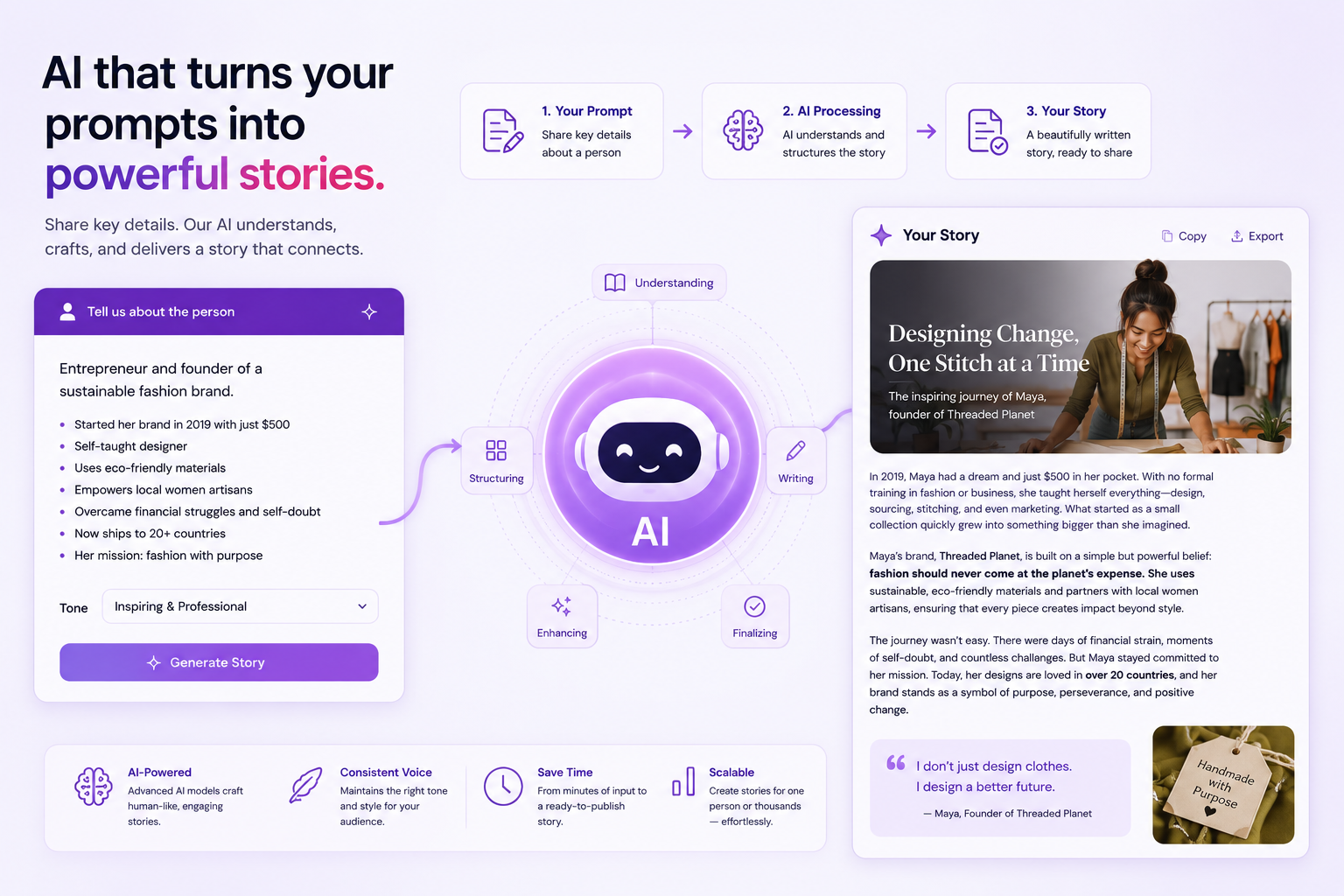
Custom ai bot

2 custom AI bots using GROK API

0
Custom AI bots built and deployed
0%
Reduction in time spent on content drafting
0%
Brand voice consistency across all AI-generated output
Challenge

Generic AI writes generically. Their audience would notice immediately.

Content generation tools are widely available. Producing output that genuinely matches an organisation's established tone and editorial standards is a different problem entirely. The client's audience — women entrepreneurs and the community that supports them — would notice immediately if the voice slipped. The tool had to be invisible in the best possible sense: the output had to read as though a human writer had produced it.
C-01

Content production was a bottleneck

The team had more stories to tell than time to tell them. Each piece took hours — raw notes, narrative structure, voice matching, SEO optimisation. A process that worked but couldn't scale.

C-02

Brand voice was non-negotiable

The organisation had built a recognisable editorial identity over years. Output in a noticeably different tone would undermine it and require heavy post-editing — defeating the purpose of the tool entirely.

C-03

Non-technical users running it daily

Staff had no technical background. The interface had to be simple enough to use confidently without training, documentation searches, or ongoing support from the development team.

C-04

SEO couldn't be an afterthought

Stories needed to meet SEO guidelines at the generation stage — not as a separate optimisation pass. Keyword density, heading structure, and meta-ready summaries had to come out of the model, not be added after.

How it works

From bullet points to publish-ready story — in under thirty minutes

STAGE — 01 / DETECT
Staff inputs bullets
Background, business, challenges, wins entered into the interface
Bot selected
Profile story or achievement piece — each routes to a separate algorithm
Context assembled
System interprets input, fills structure, flags gaps without inventing facts
Draft generated
LLM produces a full narrative in the organisation's editorial voice
Light review
Staff reads, makes minor edits — average one round, not three
Published
Output maps directly to CMS structure, ready to go with minimal reformatting
Training a model to sound like someone else — reliably

Training a model to sound like someone else — reliably

Fine-tuning AI to replicate a specific editorial voice required more than prompt engineering. We studied the organisation's existing published content in depth — sentence structure, narrative pacing, recurring phrases, tone shifts between story types, the way achievements and challenges were typically framed. That analysis became the editorial reference every training cycle was measured against. Each cycle was reviewed by the client's editorial team, with feedback used to correct for overly formal language, adjust narrative arc, and reinforce the specific framing the organisation used for women's entrepreneurship stories.
auth-middleware — role-based access
01const decoded = jwt.verify(token, process.env.JWT_SECRET)
02const { userId, role } = decoded
03if (role === 'patient') {
04patients can only access their own records
05if (req.params.patientId !== userId) {
06return res.status(403).json({ error: 'Access denied' })
07}
08}
The care cycle

A closed loop from first visit to ongoing treatment

Every patient moves through the same structured cycle — from intake to consultation to prescription to ongoing monitoring. The platform keeps both patient and provider in sync at every stage, automatically.
capabilities

Four things the system does — built around a real editorial workflow

01 — FEATURE

STORY BOT ONE

Long-form entrepreneur profiles Body: The first algorithm handles structured narrative profiles — background, business concept, milestones, challenges. Output has a clear opening, a middle that builds context, and a close that lands on impact. Length and reading level calibrated to the organisation's publishing format.

02 — FEATURE

STORY BOT TWO

Achievement and impact pieces Body: The second algorithm produces shorter, sharper impact-focused stories centred on a specific achievement or programme outcome. Trained and prompted separately — it reads like a distinct content format, not a compressed version of the profile bot.

03 — FEATURE

BACKEND & AUTH

Secure, staff-only access Body: A management backend with bcrypt-hashed passwords, session management, role-based access control, and rate-limited API endpoints. Authorised staff in, everyone else out — with no ongoing technical management required.

04 — FEATURE

CMS & SEO

Publish-ready output, every time Body: Output maps directly to the existing CMS structure — heading hierarchy, paragraph breaks, meta fields pre-populated. SEO compliance built into the generation logic: natural keyword integration, readable sentence distribution, meta-ready summaries. No separate optimisation pass needed.

Technologies

The build sheet

Ai Models
Grok 4 Custom fine-tuning Prompt engineering
Backend
Node.js
Frontend
Next.js
Auth
WT bcrypt Role-based access control Integration
integration
REST API CMS webhook integration
seo
Structured output formatting Meta field generation
Results

80% less time per story. One review round instead of three. Adopted in a week.

Both bots were delivered on schedule and integrated with the existing CMS without disrupting any active publishing workflows. What previously took two to three hours per story now takes under thirty minutes from bullet-point input to a publish-ready draft. Editorial review rounds dropped from an average of three per piece to one. SEO performance of AI-generated stories matched — and in several cases outperformed — manually written pieces in the first two months after launch. The entire content team was using both bots independently within one week of the training session, with no ongoing technical support required. Following the initial deployment, the organisation commissioned additional bot modifications to handle a new content format introduced as part of a programme expansion.
0%
Reduction in content drafting time per story
3-1
Editorial review rounds per piece after launch
1 week
Time for full staff adoption with zero ongoing support
0
Bots extended post-launch for new content formats

Need AI that sounds like you — not like AI?

We build content systems trained on your voice, your standards, and your workflow. The output should be invisible. Let's talk about what that looks like for your organisation.

Let's Talk →